

An AI blade selector gives buyers a guided path from cutting requirements to a practical recommendation.
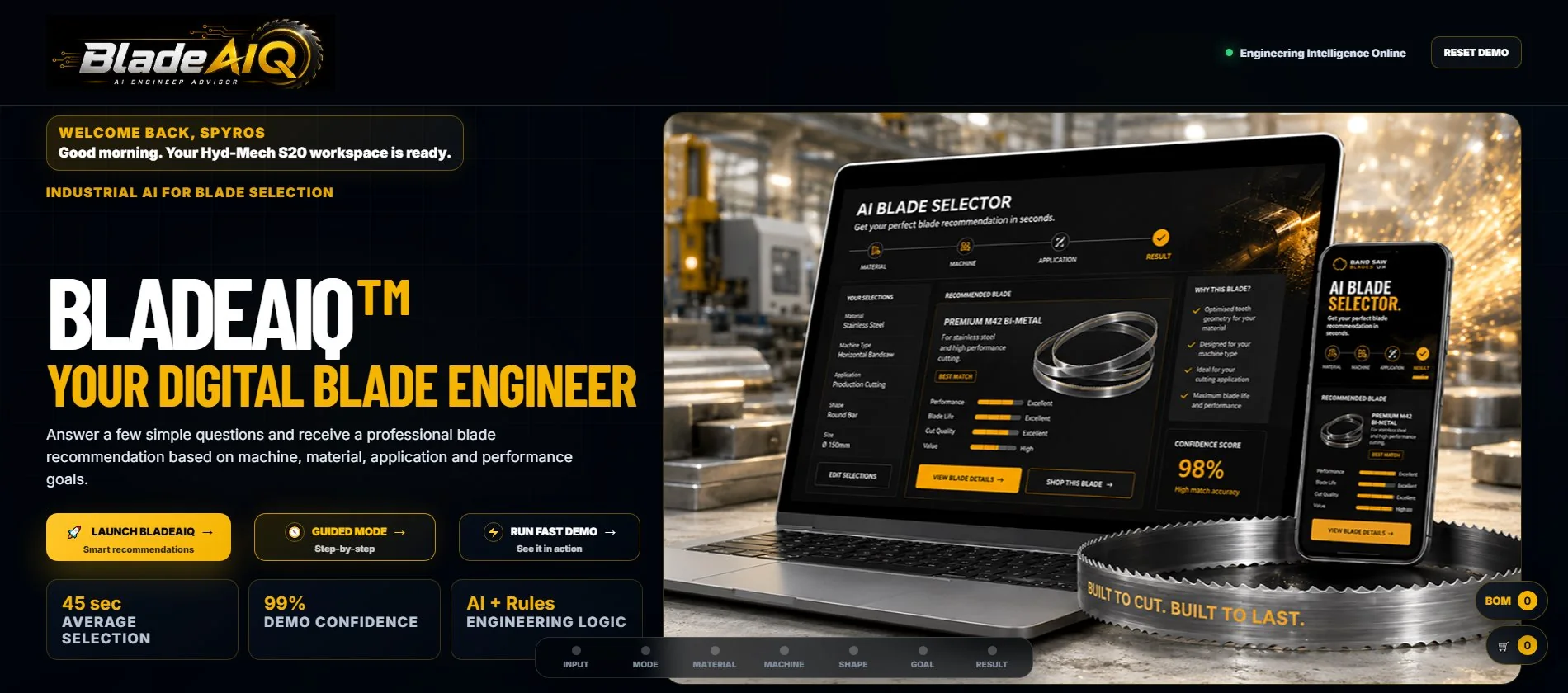
Industrial blade selection involves more than choosing a length and width. Material, machine type, stock shape, dimensions, production goals, tooth geometry, and blade construction all influence the result.
BladeAIQ demonstrates how those variables can be collected in a clear workflow, evaluated with AI and rules-based engineering logic, and turned into a recommendation that also explains why the blade fits the job.
Why bandsaw blade selection becomes difficult online
A conventional catalog can list every available blade, but it still expects the customer to translate a cutting problem into the correct technical specification.
The job has many variables
The right choice changes with material, machine, application, stock shape, size, and the outcome the operator values most.
Catalog data needs context
Technical specifications are useful only when the buyer understands how tooth pitch, construction, and geometry apply to the cut.
Recommendations can vary
Without a consistent workflow, customers and staff may reach different answers for the same application.
How the BladeAIQ selection workflow works
The demonstration guides the user through a structured decision path and keeps the process focused on the actual cutting application.
Start with a natural-language description or enter the workflow in guided mode.
Choose the material family so the system can account for cutting characteristics and blade construction.
Add the bandsaw or machine type to keep the recommendation within compatible operating conditions.
Specify round, tube, bundle, structural, or other stock geometry along with the relevant dimensions.
Prioritize blade life, cutting speed, finish, value, or a balanced production outcome.
Receive a matched blade, performance forecast, compatibility context, and reasons behind the selection.
What an AI blade configurator can deliver
The useful output is not just a product name. The configurator can connect the recommendation to the information needed to evaluate, quote, and purchase it.
Application matching
Connect the blade to the material, machine, stock geometry, and intended cutting application.
Tooth and construction logic
Apply product rules for tooth pitch, blade construction, and performance characteristics.
Performance forecast
Present the expected balance of blade life, cut quality, speed, and overall value.
Recommendation reasoning
Explain why the selected blade fits so the customer can make a more confident decision.
Commerce handoff
Connect the result to blade details, a bill of materials, a quote, or an ecommerce buying path.
Repeatable engineering knowledge
Give customers and staff a consistent selection process that remains available around the clock.
Why this matters for industrial manufacturers and distributors
A guided blade selector can make expert product knowledge easier to access without forcing every visitor to call sales or search through technical tables.
For the business, the same workflow can standardize discovery, collect better application data, and move a qualified user closer to a quote or order.
- Reduce incomplete blade inquiries and repeated specification questions
- Give less-experienced buyers a structured path through a technical catalog
- Support distributors with consistent application and product logic
- Connect engineering recommendations to quoting, pricing, inventory, and ecommerce
Explore the other StarwebAIQ configurators
Each live AIQ demonstration applies the same idea to a different industrial workflow: capture the right inputs, apply product and engineering logic, and return a useful path forward.
Frequently asked questions
What is an AI bandsaw blade selector?
An AI bandsaw blade selector is a guided configurator that evaluates cutting requirements such as material, machine, application, stock shape, size, and performance goals to recommend a suitable blade.
What information does BladeAIQ use?
The demonstration uses the cutting job, material, machine, stock shape, dimensions, and the user’s performance priorities to build a recommendation.
Can a blade selector connect to ecommerce?
Yes. A production configurator can connect recommendations to product records, customer pricing, inventory, quotes, bills of materials, and ecommerce purchasing workflows.
Does an AI selector replace an application engineer?
It is best used to make approved engineering and product logic available consistently. Complex or unusual applications can still be routed to a qualified specialist for review.
Could your catalog guide customers like an application engineer?
Starweb Designs builds industrial configurators that combine product data, engineering rules, AI guidance, quoting, and ecommerce into one customer experience.