Chain application guidance for industrial suppliers

Their drive.
Your chains.
A clearer choice.

Add ChainAIQ to your existing website.

Bring the chain’s job, geometry and operating requirements together—and give the product conversation a stronger starting point.

Duty &
environment
Geometry &
operation
Your chains.
Your brand.
CHAINAIQ BY STARWEB · BUILT AROUND THE APPLICATION
START WITH THE CHAIN’S JOBCONNECT THE REQUIREMENTSYOUR WEBSITE. YOUR CHAIN EXPERTISE.
01 / SEE HOW CHAINAIQ WORKS

From a machine requirement
to a more useful chain conversation.

Explore the actual interview: describe the application, confirm duty and environment, enter geometry and operating data, then review a suggested chain family and enquiry profile.

◎ Browser-based demo▣ Duty & environment✳ Geometry & operating data↗ Family guidance & summary
01

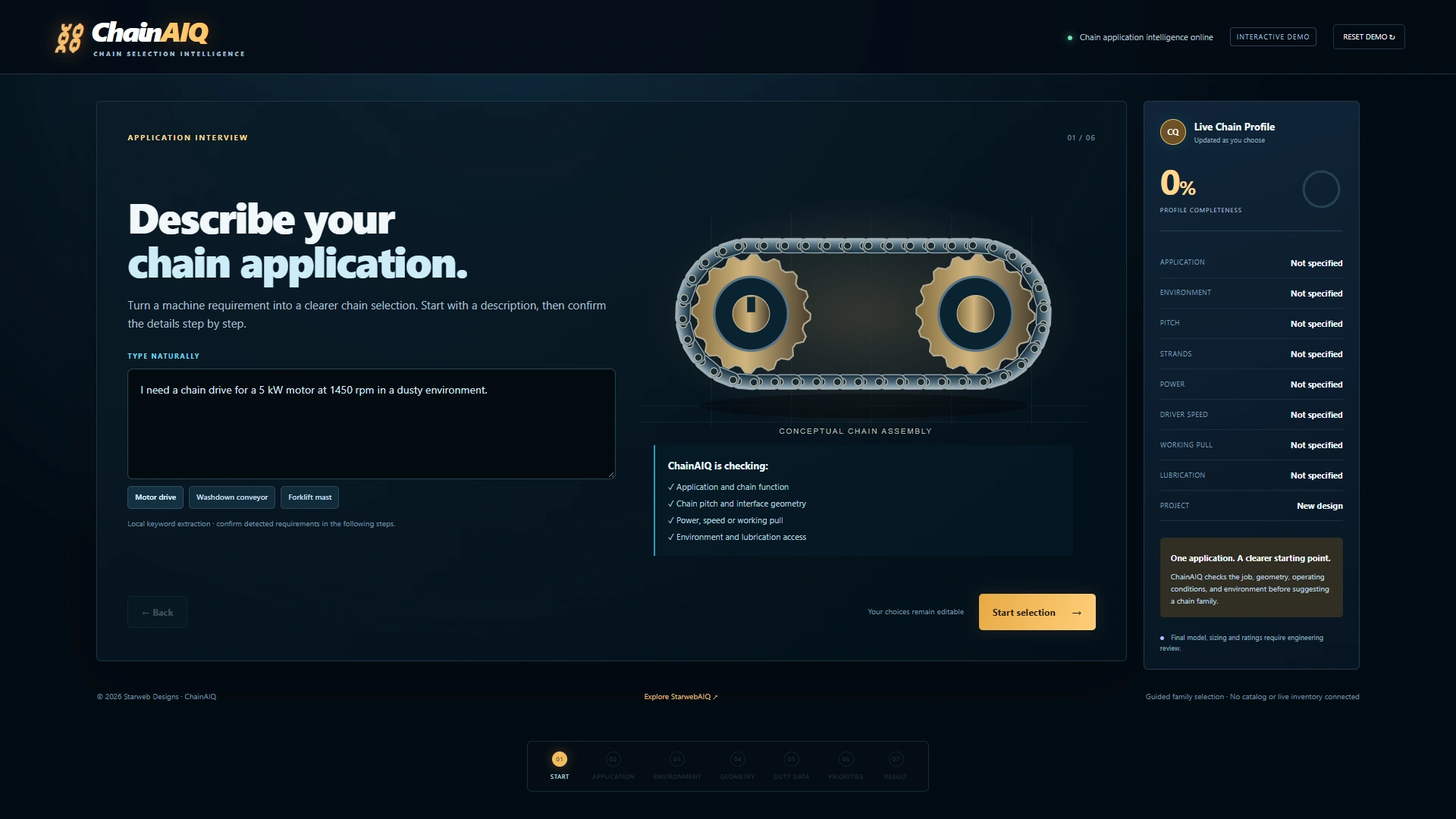
Describe the application.

Start with a machine requirement in plain language, or try one of the sample descriptions. The demo extracts local keywords, then asks you to confirm the application details. This route starts with a 5 kW motor at 1450 rpm in a dusty environment.

02

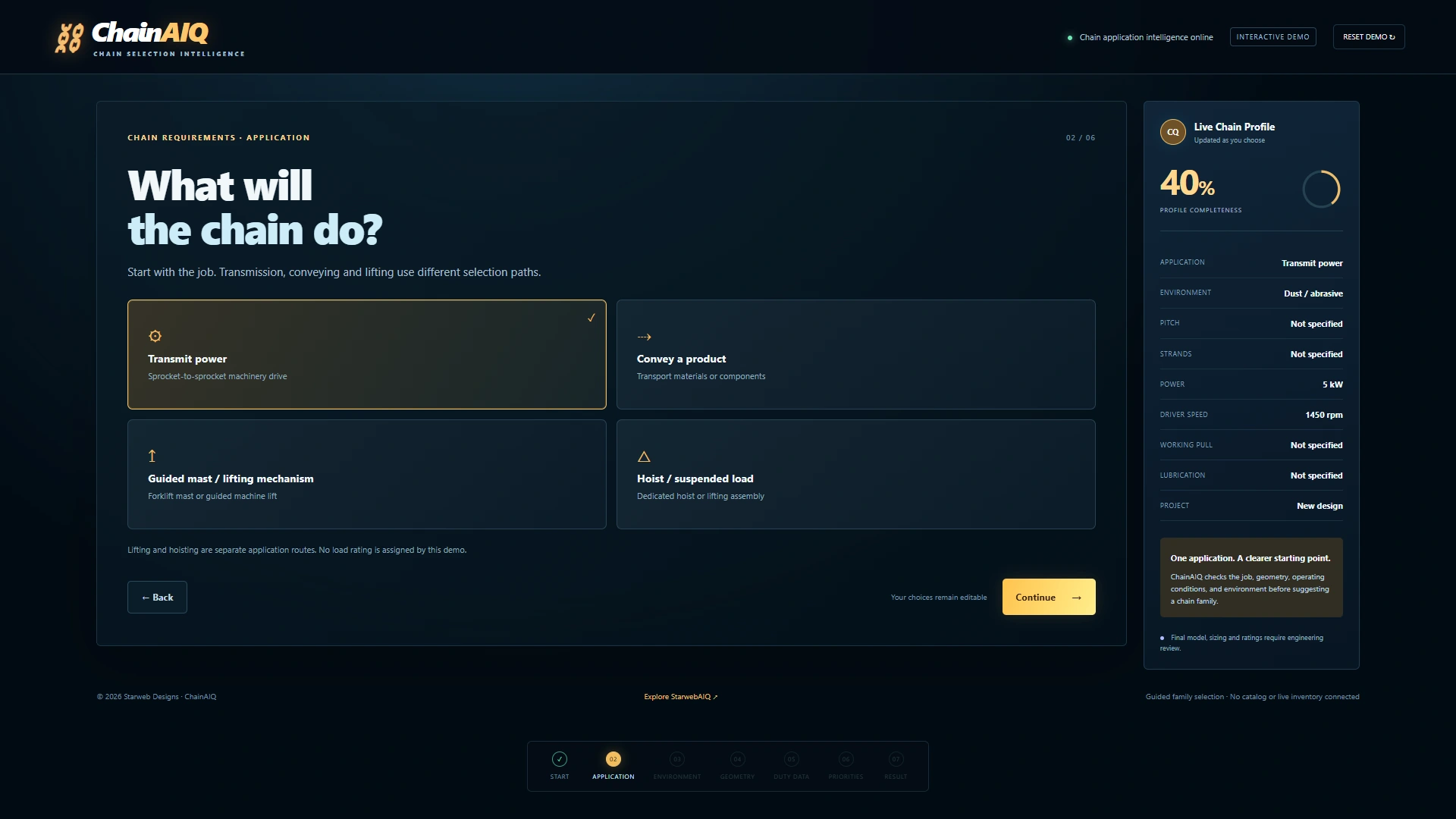
Start with the chain’s job.

Choose power transmission, conveying, a guided mast or a hoist application. These duties follow different family-selection paths; the captured route confirms a sprocket-to-sprocket transmission drive.

03

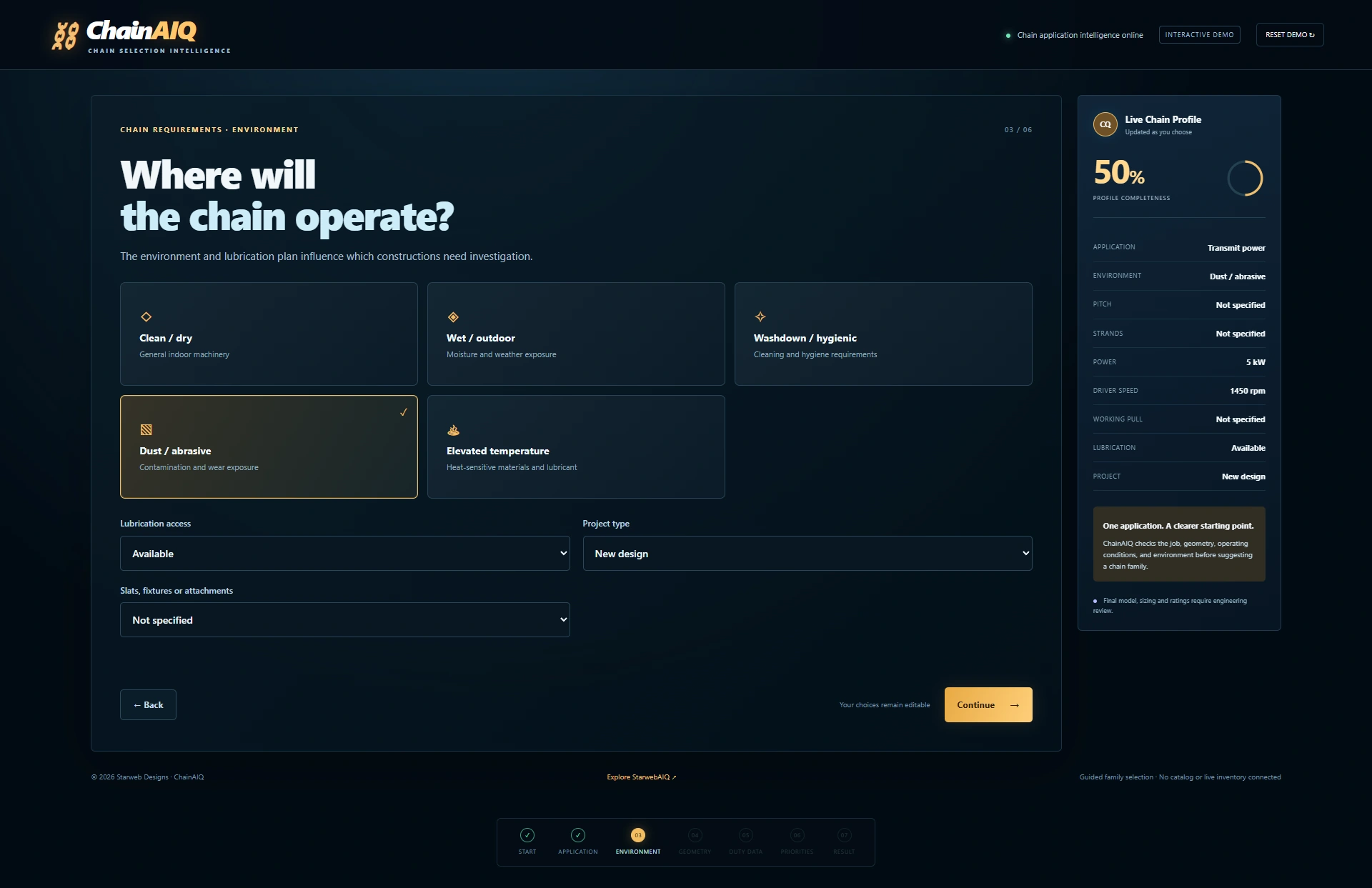
Bring the environment in.

Choose the operating environment, lubrication access, project type and attachment requirements. This example uses dust and abrasive exposure with lubrication available. Environmental suitability remains part of the final product review.

04

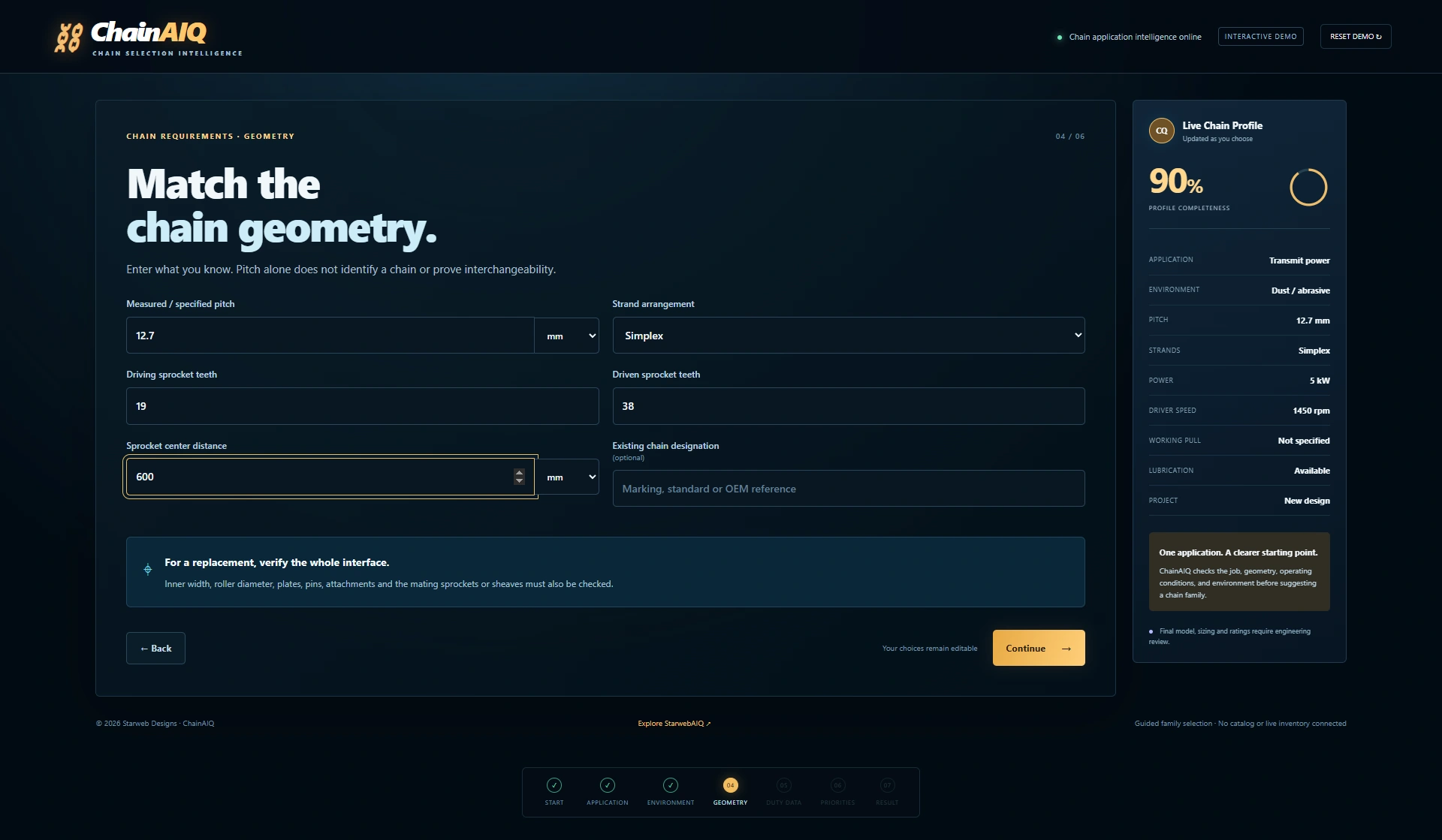
Record the known geometry.

Enter pitch, strand arrangement, sprocket teeth, center distance or existing chain markings. The sample uses 12.7 mm pitch, simplex construction, 19 and 38 teeth and a 600 mm center distance. Pitch alone does not establish a chain size or interchangeability.

05

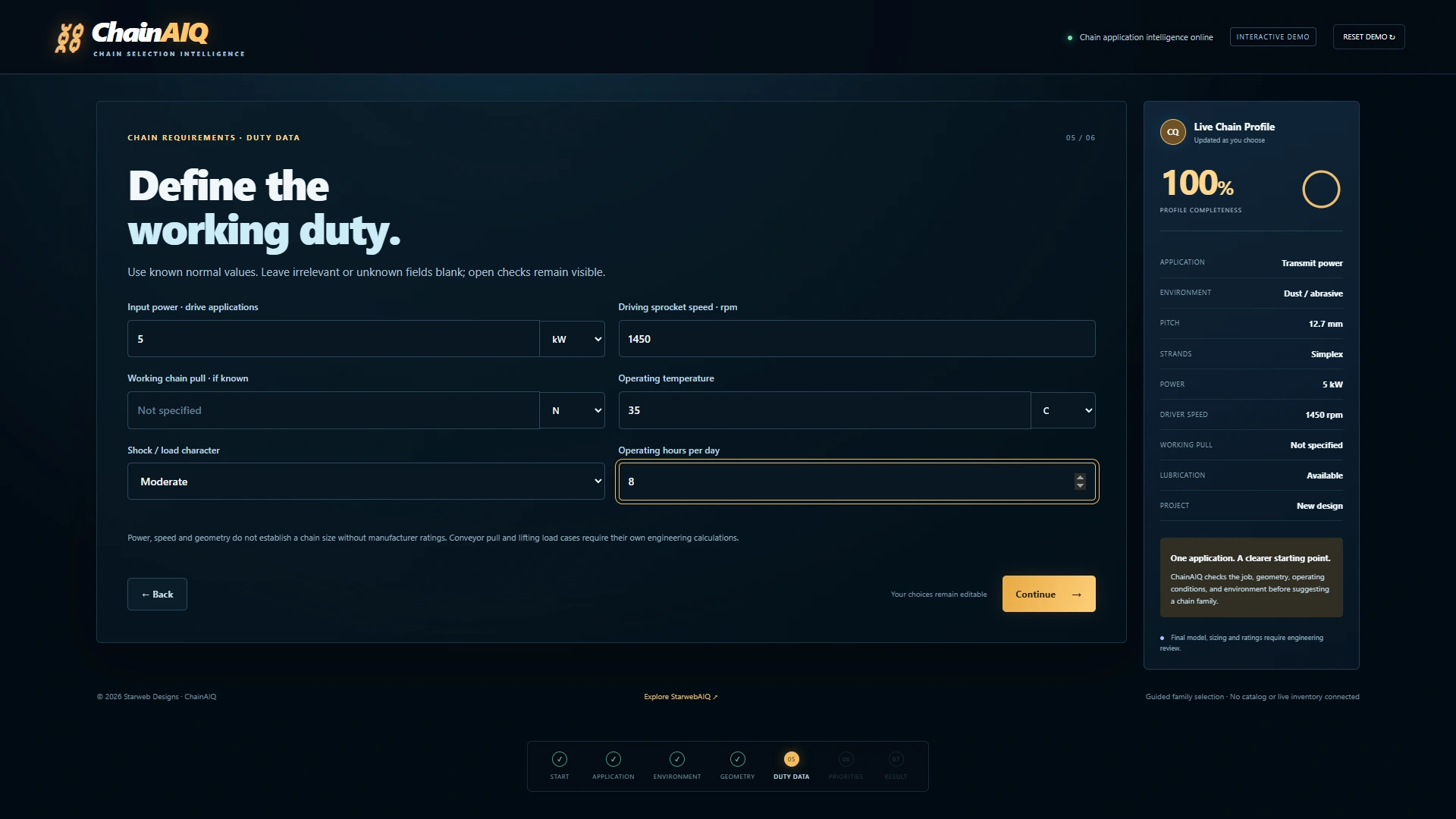
Define the working duty.

Bring known power, speed, working pull, temperature and load character together. This example retains 5 kW and 1450 rpm, then adds 35 degrees Celsius, moderate loading and eight operating hours per day. Unknown or irrelevant fields can remain open.

06

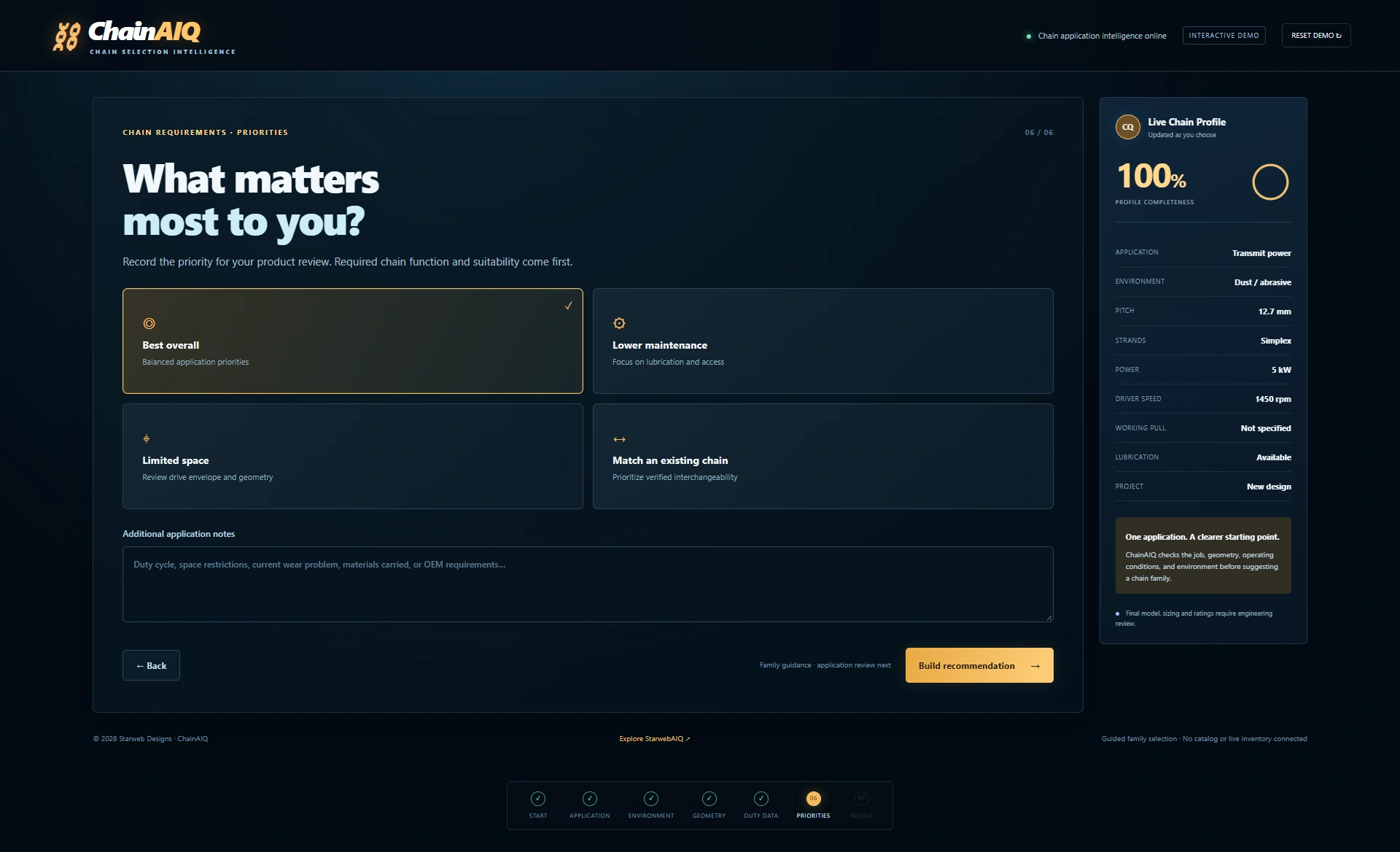
Keep the priority in view.

Choose a balanced starting point, maintenance access, limited space or matching an existing chain, and add application notes. Priorities stay with the profile for manufacturer comparison; they do not override the required chain function.

07

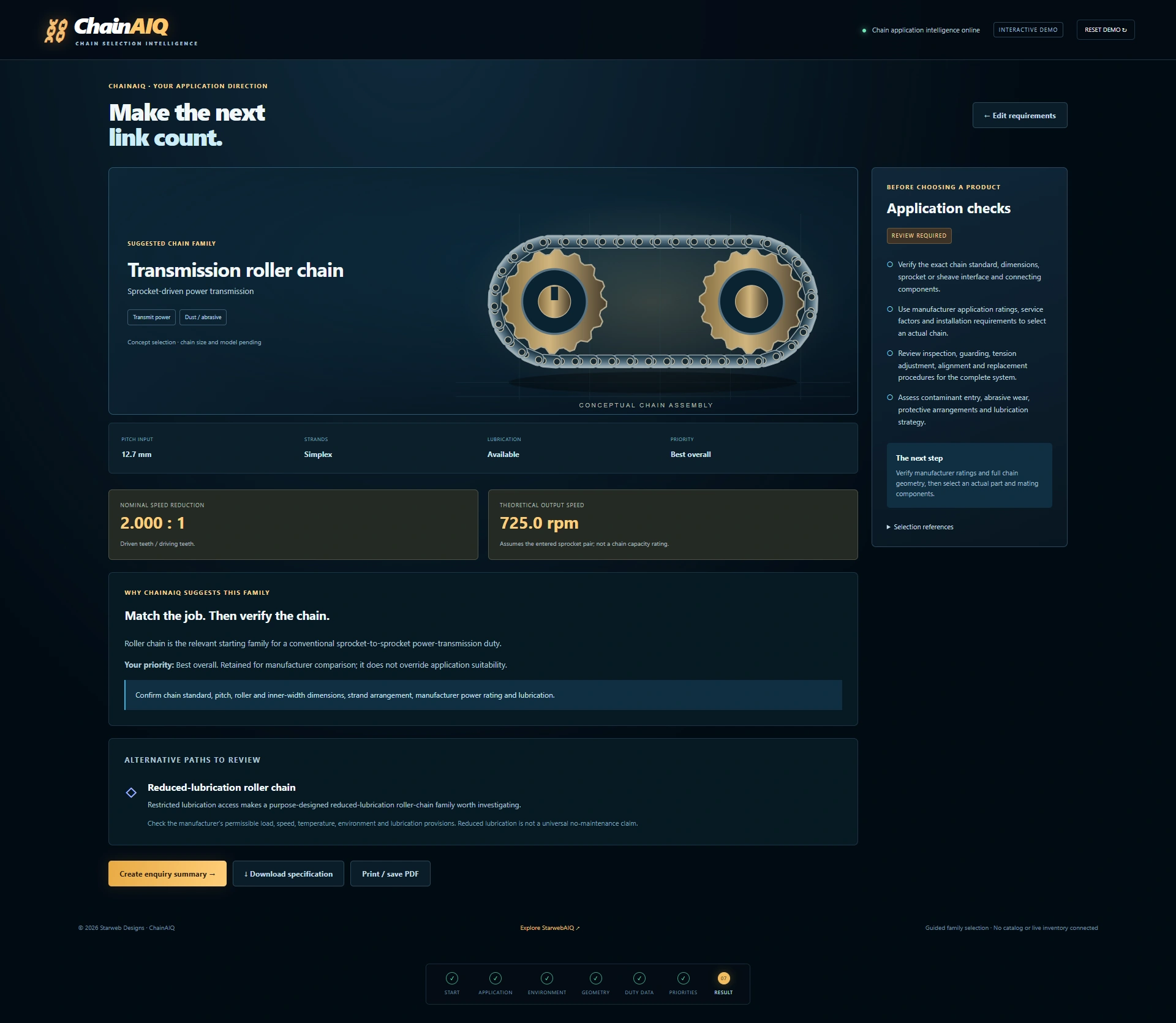
Review the suggested family.

The sample suggests transmission roller chain, explains the starting direction and lists an alternative and application checks. The 19-to-38 sprocket pair gives a 2:1 nominal reduction and 725 rpm theoretical output at the entered input speed. These calculations do not establish chain capacity or a verified part.

08

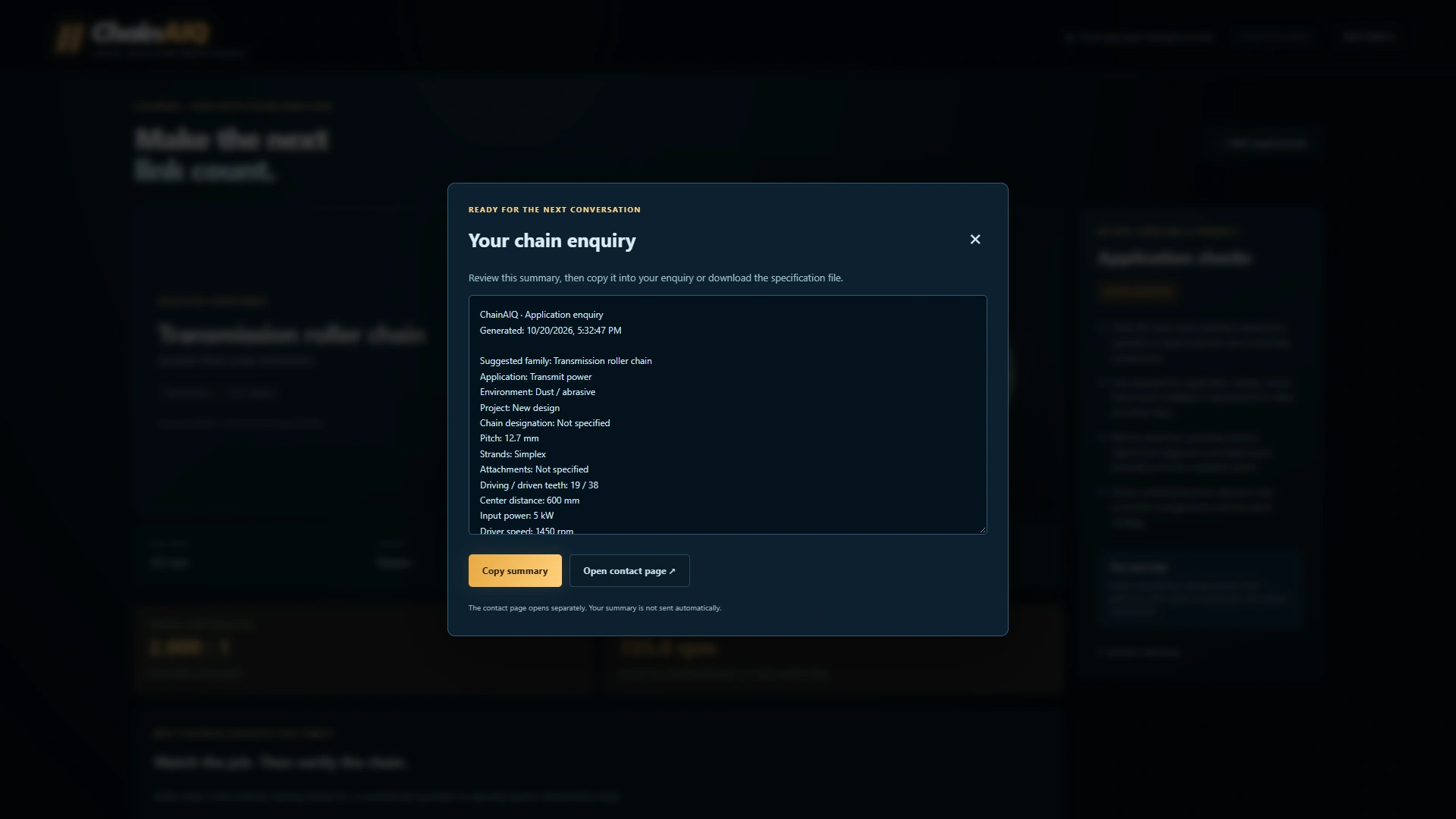
Prepare the next conversation.

Review the requirements, suggested family, nominal ratio and outstanding checks in the enquiry preview. The summary is not sent automatically. The demo separately offers copying, specification download and a contact-page link.

Actual demonstration screens. Chain-family suggestions use preliminary demo rules. Final size, manufacturer model, load capacity and any lifting ratings require application review and manufacturer data. No catalog, pricing or live inventory is connected. Production integration is scoped individually.

Your chain expertise. A better-informed starting point.

Try the interview, then review the suggested family, drive-ratio example and collected requirements.

Explore the live demo
02 / THE CHAINAIQ EXPERIENCE

A job to understand.
The details to connect.
A place to begin.

Customers may know what the chain needs to do before they know a family or designation. Help them connect the duty, operating environment and known geometry, keeping the remaining questions visible for your technical team.

Try it for yourself
01

Bring the known details together.

Application, environment, pitch, sprocket geometry, power or working pull and lubrication access build one profile as the interview progresses.

02

Explain the starting direction.

The result explains the suggested family and offers an alternative to investigate. Nominal drive-ratio calculations stay separate from the manufacturer ratings needed to select a chain.

03

Make the enquiry useful.

The enquiry preview brings the requirements, preliminary direction and open checks together. Use that profile to discuss the manufacturer data, catalog and website connections your production integration would need.

FOR CHAIN SUPPLIERS, DRIVE SPECIALISTS & INDUSTRIAL DISTRIBUTORS

Your expertise.
Your chain range.
A guided experience.

Give customers another way to describe their chain requirements. ChainAIQ demonstrates a guided starting point that can be planned around your product range, application knowledge and existing website.

Add a guided selection experience.
Keep your existing website.

  • A branded journey built around your chain range
  • Application, environment, geometry and operating requirements
  • Preliminary family guidance and an enquiry profile
  • Integration scoped around your business
Let’s talk ChainAIQ

The demo uses sample data. Your production scope is agreed individually.

THE NEXT STEP STARTS WITH A BETTER QUESTION

Let’s make the next link count.

Step into ChainAIQ
ChainAIQ demonstration screenshot

LET’S TALK ABOUT YOUR BUSINESS

Your website.
Your ChainAIQ.

Tell Starweb about your chain range, application expertise and existing website. We can explore a ChainAIQ demonstration and the integration scope that fits your business.

A conversation built around your business

Arrange a ChainAIQ demonstration with Starweb.

Want to explore first? Try the ChainAIQ demo ↗